How to Stay Motivated as an Entrepreneur When Things Are Hard
Motivation is unreliable. The entrepreneurs who build lasting businesses aren't more motivated than everyone else — they've built systems that keep them moving when motivation runs out. Here's how to build yours.
Every entrepreneur faces the same experience: an initial surge of excitement, followed inevitably by a stretch where results are slow, doubt is loud, and the gap between where you are and where you expected to be feels crushing.
Most advice about motivation treats it as a feeling you need to summon — "just believe in yourself," "visualize success," "remember your why." This advice fails because motivation is not a feeling. It's a system. The entrepreneurs who build lasting businesses aren't more naturally motivated than everyone else — they've built habits, structures, and mental frameworks that keep them moving when motivation runs out.
This guide shows you how to build those systems.
Why Does Entrepreneurial Motivation Drop Off So Predictably?
Entrepreneurial motivation drops off because the gap between expected results and actual results becomes visible around month 3–6 of any new venture. You started with a vision of where the business would be by now. Reality is different. That gap triggers a specific kind of demoralization that isn't about failure — it's about pace.
The entrepreneurs who stop at this point interpret the gap as evidence that the idea doesn't work. The entrepreneurs who continue interpret it as evidence that the timeline was wrong. One of these interpretations is almost always more accurate than the other: early-stage timelines are almost universally optimistic. The idea usually isn't the problem. The patience is.
Understanding this pattern doesn't eliminate the difficulty. But it reframes it accurately — which makes it meaningfully easier to navigate.
How Do I Keep Going When Progress Feels Invisible?
Progress feels invisible when you're measuring outputs (revenue, customers, followers) that haven't moved yet, rather than inputs (calls made, content created, systems built, skills developed) that are actually compounding in the background.
The system: Shift your primary metrics from lagging indicators (revenue) to leading indicators (actions that predictably produce revenue over time). If writing 3 blog posts per week eventually produces traffic and revenue, track whether you wrote 3 blog posts per week — not whether the traffic arrived yet. If cold outreach produces clients, track how many messages you sent — not how many clients you have yet.
When you track inputs, you can have a "successful" week even when visible results haven't moved. This is not self-deception. It's accurate measurement of the thing that's actually under your control.
What Are the Most Effective Habits for Sustaining Motivation?
Motivation follows action more reliably than action follows motivation. The most consistently motivated entrepreneurs have habits that create a feeling of momentum regardless of external results.
1. Daily minimum viable progress. Define the smallest amount of work that counts as a "win" for the day — so small you can complete it even on your worst day. One cold email. One paragraph written. One customer call scheduled. Getting that done creates forward momentum and prevents the demoralization of "I did nothing today."
2. Weekly review. Every Friday (or Sunday), spend 20 minutes reviewing: What did I accomplish this week? What didn't get done? What do I learn from the gap? What are the three most important things next week? This practice keeps you connected to your progress (which is often invisible day-to-day) and prevents the drift that kills long-term projects.
3. Monthly milestones. Break your annual goal into 12 monthly milestones. At the end of each month, formally review where you are. Celebrate what you hit. Diagnose honestly what you missed. Adjust the plan. This gives you 12 checkpoints per year instead of one annual review where you either succeeded or failed.
4. Morning activation routine. The first 30–60 minutes of your day disproportionately affects how the rest of the day goes. Successful entrepreneurs are almost universal about protecting this time — no email, no social media, no reacting to others' agendas. Instead: exercise, journaling, planning, or focused work on your highest-priority task. The specifics matter less than the intentionality.
How Do I Handle Self-Doubt as an Entrepreneur?
Self-doubt in entrepreneurship is universal. It's present in beginners because they're new. It's present in experienced founders because the stakes are higher. It never fully goes away — the goal is to make it irrelevant to your behavior.
Three effective approaches:
Action over analysis. Self-doubt is strongest when you're thinking, weakest when you're doing. The fastest way to quiet doubt is to take the next concrete action — send the email, make the call, publish the post. Doubt lives in abstraction. Action dispels it.
Evidence accumulation. Self-doubt thrives on the absence of evidence. Build a "wins file" — a running document where you record positive customer feedback, completed milestones, problems solved, and results delivered. Review it when doubt flares up. Doubt is a feeling; evidence is data. Privilege the data.
Separating identity from outcomes. The deepest self-doubt comes from tying your self-worth to business outcomes. When results are slow, you feel like a failure as a person — not just as a business owner. The antidote is deliberately maintaining areas of your life where you feel competent and effective independently of business results: a sport, a creative practice, close relationships, physical fitness. A good week at the gym doesn't solve a slow business quarter, but it prevents the slow quarter from defining your entire self-image.
How Do I Stay Motivated During a Business Slow Period?
Slow periods — when customers stop buying, growth stalls, or results plateau — are the most dangerous times for motivation because the external feedback that usually provides it disappears.
What works during slow periods:
Use the time for inputs you normally can't prioritize. A slow period is not a failure. It's space. Write the content you've been putting off. Build the system you've been too busy to build. Have the strategic conversations you haven't had time for. Future you will benefit from what you do during this period even if present you can't see it.
Talk to your customers. Nothing re-energizes a founder faster than a direct conversation with a customer who explains specifically what value they get from your product. Schedule 5 customer conversations this week if things are slow. You'll come away with product insights, testimonials, and renewed sense of purpose.
Audit, don't abandon. Slow periods tempt entrepreneurs to pivot dramatically — change the product, the market, the business model. This impulse is sometimes right and often wrong. Before pivoting, audit: Are you doing the right activities? Are you doing them consistently enough and for long enough? Are you measuring the right things? A genuine strategy failure is different from an execution consistency problem. Distinguish between them before changing course.
How Do I Prevent Burnout as an Entrepreneur?
Burnout — the state of physical and emotional exhaustion that comes from sustained overwork — is common in entrepreneurship and far easier to prevent than to recover from.
The burnout prevention framework:
Set a hard ceiling on work hours. Entrepreneurship culture glorifies working 80-hour weeks. The data is clear: sustained output above 50 hours per week leads to declining productivity per hour, poorer decision-making, and eventual burnout. Set a ceiling and protect it. Working 45 focused hours beats working 70 distracted, exhausted ones.
Build recovery into your schedule, not just your vacations. Daily and weekly recovery — exercise, sleep, time with people you enjoy, non-work activities — sustains performance over years. Vacations are insufficient recovery if every day between them is relentlessly depleting.
Distinguish between productive difficult work and unproductive grind. Hard, meaningful work is energizing even when it's challenging. Repetitive, unclear, or purposeless work is draining even when the stakes feel high. Regularly audit which type of work fills most of your time. Eliminate or delegate the draining category as quickly as resources allow.
Know your warning signs. Burnout usually gives early warnings before it fully arrives: difficulty concentrating, cynicism about the business, dreading tasks you previously enjoyed, declining quality of work, irritability. Learn your personal early warning signs and take them seriously.
What Role Does Community Play in Entrepreneurial Motivation?
Isolation is one of the most underacknowledged challenges of entrepreneurship, particularly for solo founders and early-stage business owners. Most of your social circle doesn't understand the specific pressures of building a business — which means the emotional support you need is harder to find in conventional relationships.
Community provides both practical and emotional benefits:
Practical: Other entrepreneurs share knowledge, make introductions, offer honest feedback on your ideas, and warn you about mistakes they've made so you don't have to make them yourself.
Emotional: Knowing that other capable people have felt exactly what you're feeling — the doubt, the slow periods, the loneliness — is genuinely stabilizing. You stop interpreting normal entrepreneurial difficulty as evidence of personal inadequacy.
Where to find community: online communities like Indie Hackers, local entrepreneurship meetups, niche Slack groups and Discord servers, mastermind groups of peers at similar stages, and accelerator programs.
Start Building Your Motivation System
Motivation is not something you find. It's something you build — through habits that create momentum, structures that keep you accountable, and mental frameworks that make difficulty navigable rather than defeating.
If you're still searching for the business idea worth being motivated about, the Daily Business Idea app delivers personalized business ideas every day — calibrated to your skills, budget, and what genuinely energizes you. Download it free on iOS or Android and find the idea worth betting your energy on.
More reading: 10 Mindset Shifts Every Entrepreneur Needs to Make | Daily Habits of Successful Entrepreneurs | How to Start a Small Business
More from Entrepreneur Mindset
View all Entrepreneur Mindset articles →What to Do When Your First Business Fails
Most first businesses don't work, and almost nothing written for entrepreneurs tells you what to do on the day you accept that. This is the practical version — how to close down without lasting damage, how to tell a real lesson from a comforting story, and how to decide whether to start again.
How to Manage Money as a New Entrepreneur (Before You Have Revenue)
Nobody teaches entrepreneurs how to manage money before they have a business. By the time the money challenges arrive, most are already behind. This guide covers the financial fundamentals every new entrepreneur needs — before the revenue shows up.
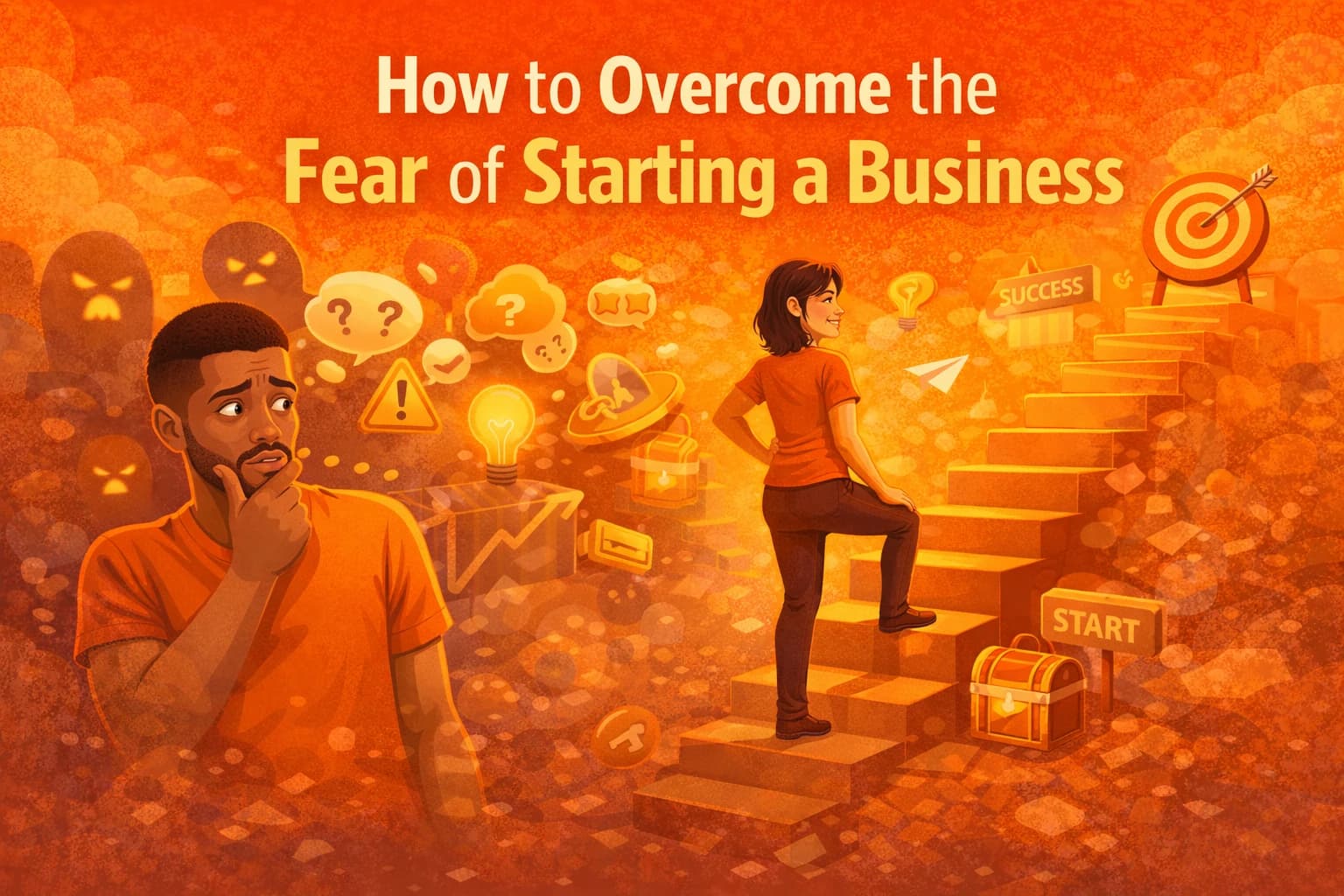
How to Overcome the Fear of Starting a Business
Almost every entrepreneur starts scared. The difference between people who build businesses and those who don't is not the absence of fear — it's that the builders eventually find a way to act despite it. This guide gives you the frameworks and exercises to do exactly that.