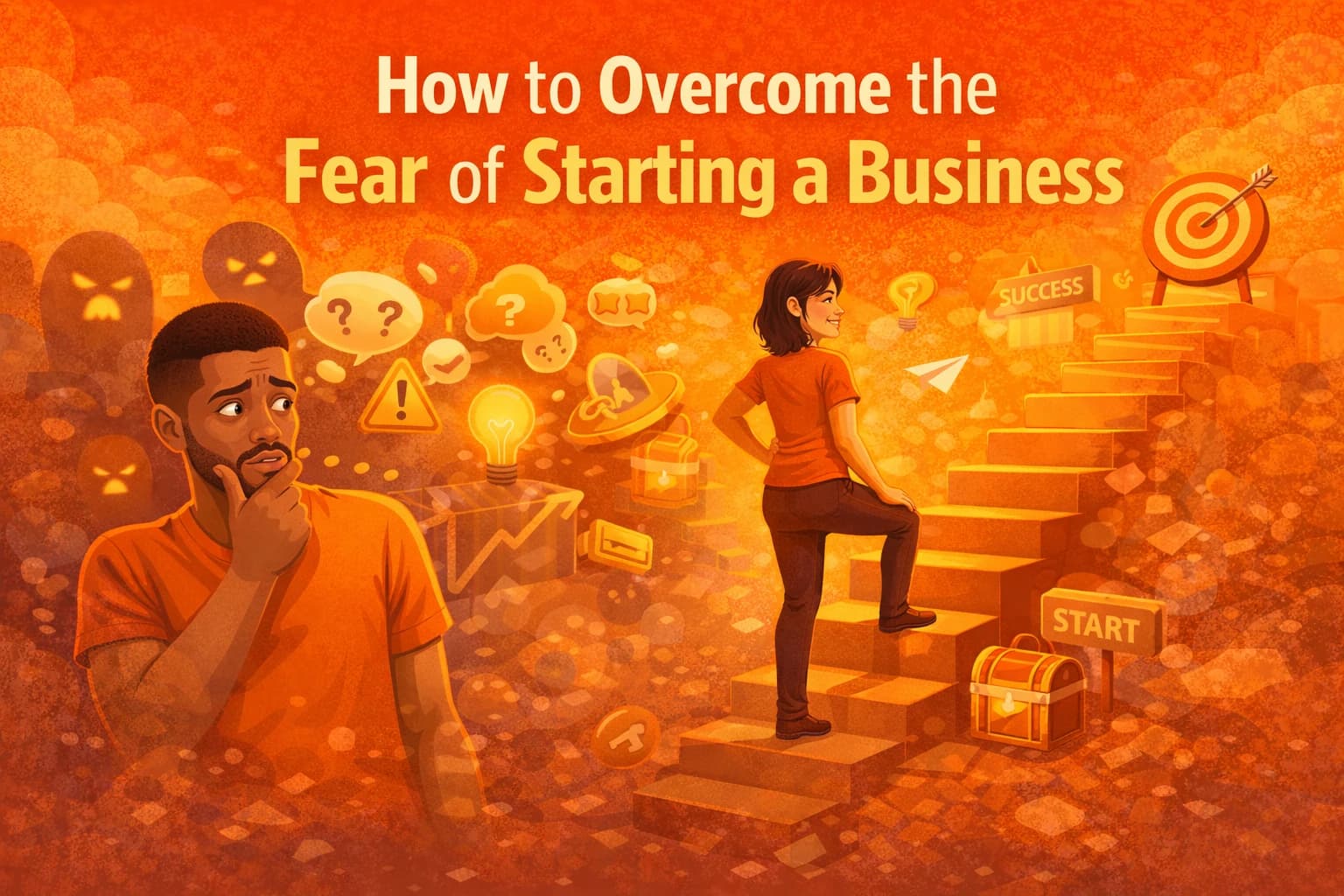
How to Overcome the Fear of Starting a Business
Almost every entrepreneur starts scared. The difference between people who build businesses and those who don't is not the absence of fear — it's that the builders eventually find a way to act despite it. This guide gives you the frameworks and exercises to do exactly that.
Almost every entrepreneur starts scared. The fear of failure, the fear of financial loss, the fear of looking foolish in front of people who know you — these are not signs that entrepreneurship is wrong for you. They are signs that you understand the stakes.
The difference between people who build businesses and people who don't is not the absence of fear. It's that the builders eventually find a way to act despite it. This guide gives you the frameworks, exercises, and mindset shifts that make that possible.
Why Are So Many People Afraid to Start a Business?
Most people are afraid to start a business because entrepreneurship involves visible risk-taking in an environment where failure is public and success is uncertain. The employee path offers predictable income, social validation, and a clear structure. Entrepreneurship offers none of those guarantees — and that gap between certainty and uncertainty is where fear lives.
Fear of starting a business tends to cluster around a few specific themes:
- Financial fear: "What if I lose my savings?" or "What if I can't pay my bills?"
- Social fear: "What will people think if I fail?" or "My family thinks this is a bad idea."
- Competence fear: "Who am I to do this? Others are more qualified."
- Future fear: "What if I commit to this and it's the wrong path?"
None of these fears are irrational. All of them are manageable. Understanding which type drives your paralysis is the first step toward addressing it specifically rather than generically.
What Is Fear of Failure and How Does It Stop Entrepreneurs?
Fear of failure is the anticipatory anxiety about a negative outcome that hasn't happened yet — and it stops entrepreneurs by making inaction feel safer than action. The problem is that inaction has its own consequences. The business you don't start is the income you don't earn, the skills you don't develop, and the version of yourself you never meet.
Fear of failure operates on a cognitive distortion: it treats the worst-case scenario as the most likely scenario. In reality, "starting a business" rarely ends with bankruptcy and ruin. It usually ends with either a working business or a learning experience that makes you significantly more capable than you were before you started.
A reframe that works: Instead of asking "What if this fails?" ask "What's the worst realistic outcome, and can I survive it?" For most people, the honest answer is: the worst realistic outcome is wasting 6–12 months and a few hundred dollars while learning a lot. That's survivable. That's actually pretty close to what college costs.
What Is Analysis Paralysis and How Do I Break Out of It?
Analysis paralysis is the state of being unable to make a decision because you keep gathering more information or exploring more options in an attempt to find the "perfect" answer before acting. It feels productive because you're busy — reading business books, watching YouTube videos, researching markets — but nothing is actually moving forward.
Analysis paralysis is fear wearing a productivity costume. The research isn't the problem. The refusal to act on incomplete information is the problem.
How to break out:
Set a decision deadline. Give yourself a specific date by which you will make one concrete decision — not the perfect decision, a specific decision. "By Friday, I will pick one business idea and tell two people I'm pursuing it." The social commitment helps.
The "good enough to start" standard. Replace "I'll start when I know enough" with "I know enough to take the next step." You don't need all the answers to make progress. You need the answers to the next three questions only.
Minimum viable action. What is the smallest possible action that moves you forward? Not "start a business" — that's too big. "Write down the problem I'm solving." "List 10 potential customers." "Send one email." Do that today.
Information diet. If you've read three books, watched 20 YouTube videos, and taken two online courses on your topic, you have more information than you need. Stop consuming. Start producing.
How Do I Manage the Fear of Financial Loss When Starting a Business?
The fear of financial loss is the most rational fear on this list — and the most manageable one with the right preparation. The antidote is structural: reduce the actual financial risk before you start rather than trying to convince yourself it doesn't exist.
Build a runway before you need it. The most effective way to start a business without financial terror is to have 6–12 months of personal expenses saved before you launch. This changes the emotional math entirely. With a runway, a slow first month is a learning experience. Without a runway, a slow first month is a crisis.
Start while employed. Most successful businesses started as side projects alongside a primary job. This eliminates the financial pressure entirely — any revenue you generate is upside, and if the business doesn't work, you still have income. The "quit your job and go all in" narrative is mostly mythology. Most successful founders maintained some income for longer than they publicly admit.
Right-size the risk. Not every business requires significant capital. Many service businesses — consulting, freelancing, coaching, virtual assistance — can be started for essentially $0. The financial risk in these models is opportunity cost (time you could have spent elsewhere), not capital loss.
Know your number. Write down exactly how much money you'd need to survive for 12 months if your business generated zero revenue. Knowing the exact number — $3,847/month, say — demystifies it and makes it plannable. Vague fears feel larger than specific ones.
How Do I Deal with the Fear of What Others Will Think?
Fear of judgment — what your parents, partner, colleagues, or social circle will think if you try and fail — is one of the most paralyzing fears for aspiring entrepreneurs, and one of the least discussed.
Here's the uncomfortable reality: some people in your life will be skeptical, dismissive, or quietly rooting against you. This is almost always projection — your success highlights the chances they didn't take — rather than a genuine assessment of your potential. The people who love you most might give you the most discouraging advice because they're trying to protect you from a risk they're projecting their own fears onto.
Reframe the social stakes. Ask yourself: in five years, will you care more about the opinion of your skeptical coworker or the outcome of building something? Most people, honestly examined, care far more about the outcome than the opinion. The fear feels huge in the moment and tiny in retrospect.
Selective disclosure. You don't have to tell everyone. In the early stages of a business, you need maybe three people who believe in you unconditionally and zero critics. Share your plans selectively with people who are supportive by nature. Don't have the conversation that will make you feel bad before you've had a chance to build momentum.
The 10-year test. Will you care what your current coworker thought about your business idea in 10 years? Genuinely? Almost certainly not. Will you care that you spent 10 years not trying? Almost certainly yes.
What Is Imposter Syndrome and How Do I Overcome It as an Entrepreneur?
Imposter syndrome is the persistent feeling that you're not qualified to do what you're doing and that others will eventually discover you're less capable than they think. It affects the majority of entrepreneurs — including experienced, highly successful ones — and it is not a sign that you're actually unqualified.
The research on imposter syndrome consistently shows that it tends to affect competent, self-aware people more than genuinely unqualified ones. Dunning-Kruger works in reverse here: the less you know, the more confident you feel; the more you know, the more you understand what you don't know.
The evidence method. Start deliberately collecting evidence that you are capable. Save client testimonials, positive feedback emails, and wins — however small — in a document or folder. When imposter syndrome strikes, open the folder. You are building a physical record of your competence that your brain cannot dismiss.
"Doing it anyway" is the only cure. You cannot think your way out of imposter syndrome. You can only act your way out of it. Every project you complete, every client you help, every problem you solve deposits confidence into an account that imposter syndrome gradually depletes. Keep depositing.
The qualification paradox. No one is born qualified to start a business. Richard Branson wasn't qualified to run an airline. Jeff Bezos wasn't qualified to build an e-commerce giant. Sara Blakely wasn't qualified to create a fashion brand. They became qualified by doing it. You will too.
How Do I Take Action When I Don't Feel Ready?
You take action when you don't feel ready by separating the feeling of readiness from the decision to act. Readiness is a feeling — and feelings are not reliable guides to when you should take external action. You will almost never feel ready to do something genuinely new.
The professionals who move quickly through fear use a simple cognitive reframe: "I don't have to feel ready. I just have to do the next step." The step is tiny. It doesn't require readiness. It just requires that you move.
Break it into the smallest possible unit. "Start a business" is not a step — it's a destination. What is the one action you could take in the next 20 minutes that moves you in that direction? That's your step. Do that.
Public commitment. Tell one person — one friend, a partner, or a colleague you respect — that you are taking one specific step this week. The social accountability dramatically increases follow-through for most people.
Schedule it. Put the first action on your calendar like an appointment. "Tuesday at 7:00pm — write down 5 potential customers for my consulting idea." Treat it like a meeting you can't miss.
What Are Practical Exercises to Build Entrepreneurial Courage?
Building entrepreneurial courage is a trainable skill — not a personality trait you either have or don't. These exercises expand your comfort zone gradually, building the neurological pattern of "I was afraid and I acted anyway."
Rejection therapy. Practice getting rejected on purpose in low-stakes situations. Ask for a discount at a store. Request an upgrade at a hotel. Apply for something you don't think you'll get. Each small rejection you survive makes the prospect of business rejection less terrifying. The goal is to discover that rejection doesn't actually hurt as much as you expected.
Fear journaling. Write out your fears about starting your business in specific detail. Then write the realistic worst-case scenario. Then write the most likely outcome. Then write what you would do if the worst case happened. This process consistently shows people that their worst-case scenario is survivable and their most-likely-case scenario is much better than their fear suggested.
Minimum viable experiments. Instead of "starting a business," run a tiny experiment. Offer your service to one person for free or at a heavy discount in exchange for feedback. You're not starting a business — you're running an experiment. Experiments can't fail; they only produce data.
The 2-minute rule. If a task connected to your business takes less than 2 minutes, do it immediately. This prevents the pile-up of small undone things that collectively feels overwhelming.
How Do Successful Entrepreneurs Deal with Fear?
Successful entrepreneurs deal with fear the same way everyone else does — they feel it fully and act anyway. The fantasy that successful founders are fearless is a myth perpetuated by polished retrospectives that skip the terrified middle chapters.
What distinguishes the people who build things is not that they feel less fear. It is that they have developed a higher tolerance for discomfort, a more accurate assessment of risk, and a clearer sense of what they're building toward that makes the fear worth enduring.
The practical tools successful entrepreneurs use:
- Decision frameworks that separate emotional reaction from strategic analysis
- Mentors and peer groups who have experienced similar fears and normalized them
- Bias toward action — a default of "do something" when uncertainty peaks
- Long time horizons — the knowledge that most things that feel catastrophic in week one are forgettable by month six
The fear doesn't go away. You get better at acting alongside it.
Take Your First Step Today
The most effective antidote to fear is a single concrete action. Not a plan. Not more research. One action, taken today.
If you don't yet have a business idea you're excited about, start there. The Daily Business Idea app delivers personalized business ideas daily — tailored to your skills, budget, and goals — so you can find something worth being scared about. Download it free on iOS and Android.
Once you have an idea, the next step is validation. Read our guide on how to validate a business idea to test your concept before committing significant time or money.
Keep Reading
More from Entrepreneur Mindset
View all Entrepreneur Mindset articles →What to Do When Your First Business Fails
Most first businesses don't work, and almost nothing written for entrepreneurs tells you what to do on the day you accept that. This is the practical version — how to close down without lasting damage, how to tell a real lesson from a comforting story, and how to decide whether to start again.
How to Stay Motivated as an Entrepreneur When Things Are Hard
Motivation is unreliable. The entrepreneurs who build lasting businesses aren't more motivated than everyone else — they've built systems that keep them moving when motivation runs out. Here's how to build yours.
How to Manage Money as a New Entrepreneur (Before You Have Revenue)
Nobody teaches entrepreneurs how to manage money before they have a business. By the time the money challenges arrive, most are already behind. This guide covers the financial fundamentals every new entrepreneur needs — before the revenue shows up.