How to Use ChatGPT for Your Business (Practical Guide for 2026)
ChatGPT has moved from novelty to business infrastructure in three years. Entrepreneurs who use it well aren't just saving time — they're doing things that were previously out of reach for a solo operator. Here's how to actually put it to work in your business.
In 2022, ChatGPT was a novelty that impressed people at parties. In 2026, it's infrastructure — used daily by millions of entrepreneurs for tasks that previously required hiring, outsourcing, or simply not getting done.
But there's a substantial gap between knowing ChatGPT exists and knowing how to use it in a way that produces real results. Most small business owners who've tried it got mediocre outputs, concluded it wasn't that useful, and moved on. The problem isn't the tool — it's that nobody taught them how to use it.
This guide closes that gap.
What Can ChatGPT Actually Do for a Small Business?
ChatGPT is a large language model that excels at producing, editing, transforming, and reasoning about text. For small businesses, this translates to practical value across several domains:
- Content creation: Blog posts, social media captions, email newsletters, product descriptions, website copy
- Customer communication: Email templates, response drafts, FAQs, onboarding messages
- Marketing: Ad copy, landing page copy, promotional scripts, content calendars
- Operations: SOPs, meeting agendas, policy documents, training materials
- Research: Market summaries, competitor analysis, industry overviews
- Strategy: Business plan drafts, problem analysis, decision frameworks
- Learning: Explanations of any concept relevant to your business
What it cannot reliably do: access real-time information (unless you're using the web browsing feature), guarantee factual accuracy on specific data points, replace genuine creative direction, or execute actions in the physical world.
How Do I Write Better Prompts to Get Better Results?
The quality of ChatGPT's output is almost entirely determined by the quality of your prompt. Vague input produces vague output. Specific, detailed input produces specific, useful output.
The anatomy of a strong business prompt:
- Role: Tell it who it's acting as. "Act as a marketing copywriter specializing in SaaS companies."
- Context: Give it relevant background. "I'm building a productivity app for remote teams. Our main competitor is Asana. Our key differentiator is a simpler, faster interface."
- Task: Be specific about what you want. Not "write something about my product" but "write a 150-word product description for our homepage that highlights the time-saving benefit and ends with a call to action."
- Format: Specify how you want the output structured. "Bullet points," "numbered list," "one paragraph," "table format."
- Tone: Tell it how to sound. "Professional but conversational," "casual and friendly," "authoritative."
Weak prompt: "Write an email about my new product"
Strong prompt: "Act as a direct-response copywriter. Write a 200-word launch email for a new project management tool for freelancers. The tool saves freelancers an average of 3 hours per week on admin work. The tone should be direct and results-focused. Start with a question that speaks to time pressure. End with a clear CTA to start a 14-day free trial."
The strong prompt produces something you might actually send. The weak prompt produces something that needs complete rewriting.
How Do I Use ChatGPT for Content Marketing?
Content marketing is one of the highest-leverage applications of ChatGPT for small businesses. Here's how to build a complete content production system using AI.
Blog content workflow:
- Keyword research (use Ahrefs or Google's "People Also Ask" to find questions your target customers are searching)
- Prompt for an outline: "Act as an SEO content strategist. Create a detailed outline for a blog post targeting the keyword '[keyword]'. Include an intro, 6–8 H2 sections, and a conclusion. Each section should address a specific question a beginner would have."
- Prompt for each section: "Expand this section of the outline into 300–400 words. Write in a clear, practical style. Include a specific example. Avoid generic advice — give readers something actionable."
- Edit and add your expertise: Add real examples from your own experience, facts specific to your industry, and your genuine perspective. This is where human judgment adds value that AI can't replicate.
- SEO review: Prompt ChatGPT: "Review this article for SEO. Suggest where to naturally include the focus keyword, related terms, and any structural improvements."
Social media content workflow:
- Feed it your blog post and ask for 5 LinkedIn post variations based on it
- Feed it a customer testimonial and ask for 3 social captions that use the testimonial's language
- Ask it to create a 4-week content calendar for your business, with post topics for each day
How Do I Use ChatGPT for Customer Service?
Customer service is a time sink for most small business owners. ChatGPT can dramatically reduce the time you spend on it without reducing quality.
Build a FAQ document: List the 20 most common questions customers ask you. Prompt: "Turn these questions and my draft answers into a professionally written FAQ document. Make the answers clear and concise. Add a friendly, helpful tone throughout."
Draft email responses: Paste an incoming customer email and prompt: "This is an email from a customer. Write a professional, helpful response that acknowledges their concern, explains the situation, and offers a clear resolution. Match the following guidelines: [your refund policy, your response norms]."
Create response templates: "Write 5 email templates for common customer service situations: order delay, refund request, product question, complaint resolution, and a follow-up after a problem is resolved. Keep each under 150 words. Tone: warm and professional."
Once you have templates, responding to customer emails takes minutes instead of an hour.
How Do I Use ChatGPT for Marketing and Ad Copy?
Marketing copy is where ChatGPT delivers some of its clearest ROI. Producing, testing, and refining copy is dramatically faster with AI assistance.
Facebook and Instagram ads:
"Write 5 variations of a Facebook ad for [product]. Our target customer is [description]. The key benefit is [benefit]. Each variation should have a different hook: one starts with a question, one with a bold claim, one with a story, one with social proof, one with a direct offer. Keep each headline under 10 words and the body copy under 100 words."
Email subject lines:
"Write 20 email subject lines for a promotional email about [offer/product]. Target audience: [description]. Mix curiosity-driven, benefit-driven, and urgency-driven approaches. Keep each under 50 characters."
Landing page copy:
"Act as a conversion copywriter. Write a landing page for [product]. Include: a headline that speaks to the customer's core problem, a subheadline that introduces the solution, three bullet points of key benefits, a short proof section (I'll add real testimonials), and a CTA button text. Keep the total copy under 300 words."
How Do I Use ChatGPT for Business Operations?
Beyond marketing, ChatGPT produces significant leverage in the internal operations of a small business.
Standard Operating Procedures: "Write a step-by-step SOP for [process — e.g., onboarding a new client]. Include every step an employee would need to complete the process independently. Use a numbered list format."
Meeting agendas: "I have a 30-minute meeting with a potential client who runs a [type of business]. They're interested in [my service]. Create a structured agenda that opens with rapport-building, moves to understanding their needs, introduces my solution, and closes with a clear next step."
Job descriptions: "Write a job description for a part-time social media manager for a small [industry] business. Include responsibilities, required skills, and a salary range of $[X]–$[X]. Keep it under 400 words. Tone: professional but approachable."
Legal and policy documents (as a starting draft only): "Draft a refund policy for a digital products business. Include sections on [your specific terms]. Note: This will be reviewed by a legal professional before use."
What Are the Limitations I Should Know About?
Factual accuracy is not guaranteed. ChatGPT can confidently produce incorrect statistics, outdated information, or fabricated citations. Always verify specific facts and data points before publishing.
It doesn't know your business. General prompts produce general output. The more specific context you give it — your brand voice, your customers, your differentiators — the more useful the output becomes.
It's not a replacement for expertise. For legal documents, financial advice, medical content, or highly technical fields, ChatGPT produces starting drafts that require expert review. Use it to accelerate your work, not to replace professional judgment in high-stakes areas.
Consistency requires effort. ChatGPT will write in different styles across different conversations unless you consistently prime it with your brand voice guidelines. Create a "system prompt" or style guide and paste it at the beginning of each session.
Start Using ChatGPT in Your Business Today
The fastest way to get value from ChatGPT is to replace one specific recurring task in your business workflow with an AI-assisted version this week. Pick the task that takes you the most time and produces the least enjoyment — that's usually where the leverage is greatest.
For entrepreneurs who are still building toward having a business to apply these tools to, Daily Business Idea delivers personalized business ideas every day — calibrated to your skills, budget, and goals. Download it free on iOS or Android.
More reading: Best AI Tools for Entrepreneurs | AI-Powered Side Hustles | How to Validate a Business Idea Using AI
More from AI & Entrepreneurship
View all AI & Entrepreneurship articles →AI Automation for Small Business: 10 Workflows Worth Setting Up
Most AI automation advice hands you a list of tools and leaves you to work out what to do with them. This is the other way round — ten specific repetitive jobs a small business can hand over this week, roughly what each saves, and the three things you should keep doing yourself.
No-Code AI Business Ideas You Can Build Without Programming in 2026
Building an AI-powered business no longer requires software engineering skills. No-code tools have made it possible for anyone to build and sell AI-powered products and services. Here are the best no-code AI business ideas you can start in 2026.
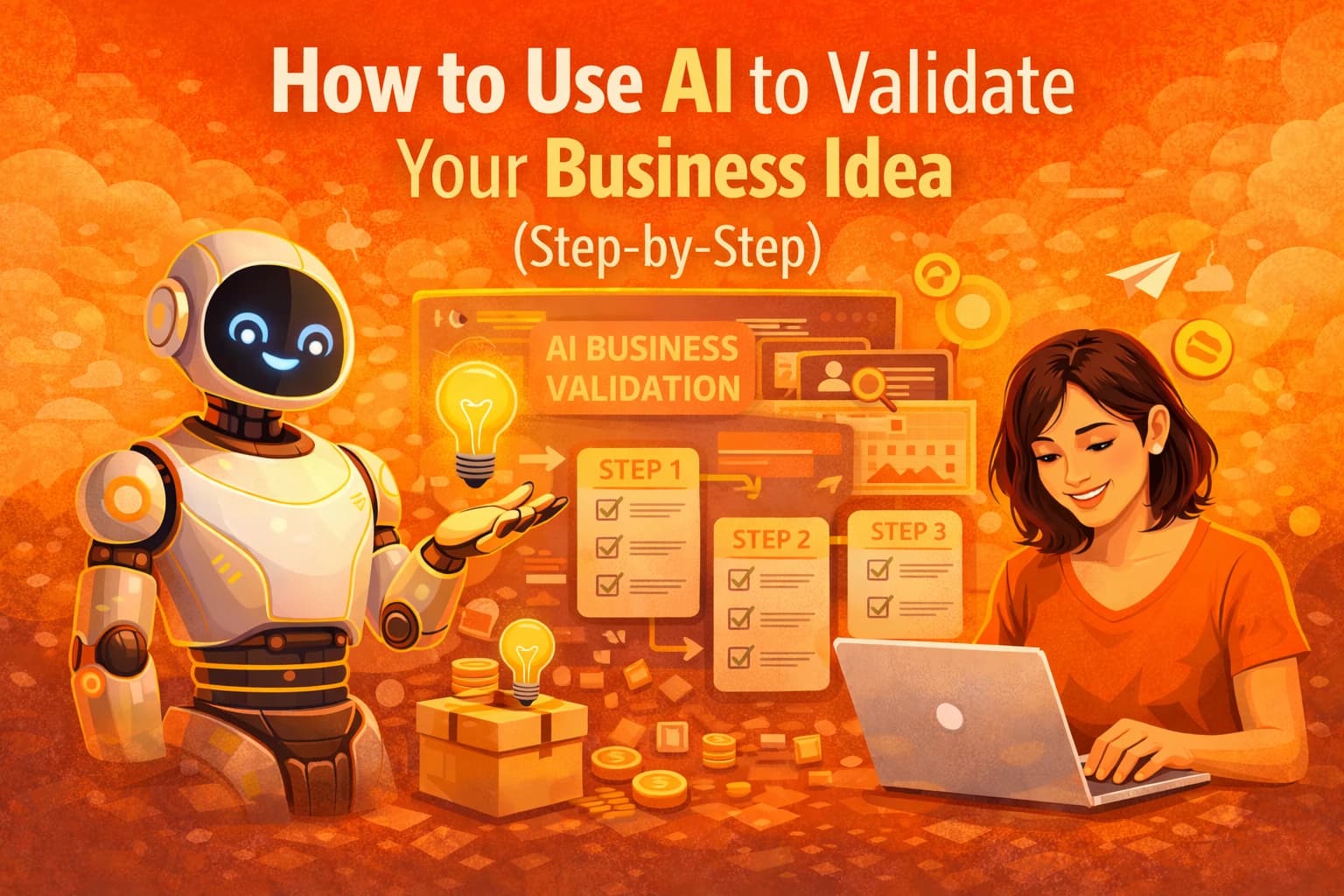
How to Use AI to Validate Your Business Idea (Step-by-Step)
he traditional validation process took 3–6 months. AI has compressed that timeline to days. A motivated founder can now run a credible validation process using freely available tools — without sacrificing research depth. Here's the exact step-by-step process.